Science Glossary
Health And Life Science
This glossary will help you understand the meaning of many terms often used in science in general.
- metabolism
- noun
- The total sum of all chemical reactions happening in a living organism to maintain life.
- Example: The proper functioning of this bacterium’s metabolism depends on many various factors.
- fr: métabolisme
- atom
- noun
- The basic building block of all matter in the universe.
- Example: Everything in this world is made out of atoms.
- fr: atome
Indolences.Recoloring and ironing out some glitches done by Rainer Klute. -">
- toxicology
- noun
- The scientific study of harmful effects, poisons, and toxic substances on living organisms.
- Example: In two years, I want to study toxicology.
- fr: toxicologie
- microscope
- noun
- A scientific instrument used to make an enlarged image of a small object, revealing details that are invisible to the naked eye.
- Example: If you need to analyse molecules, you need to use a microscope.
- fr: microscope
Mikael Häggström, M.D. Author info- Reusing images- Conflicts of interest: NoneMikael Häggström, M.D. - Own work, CC0, Link">
- microorganism
- noun
- Tiny living things that are too small to see without a microscope.
- Example: Bacteria and virus are microorganisms.
- fr: microorganisme
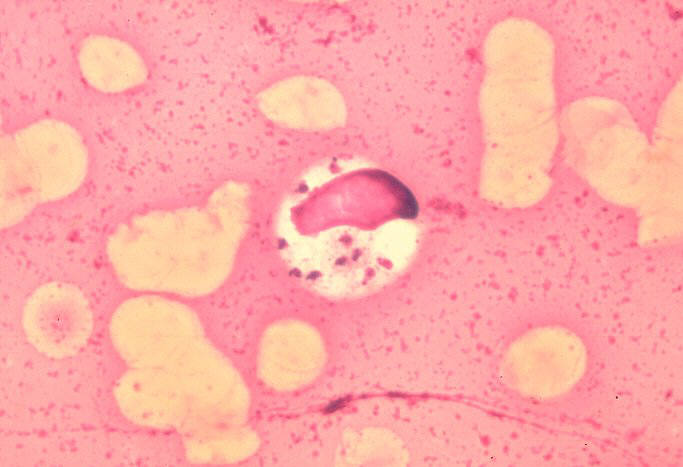
This media comes from the Centers for Disease Control and Prevention's Public Health Image Library (PHIL), with identification number #468.Note: Not all PHIL images are public domain; be sure to check copyright status and credit authors and content providers.http://phil.cdc.gov/PHIL_Images/10231998/00019/05G0001_lores.jpg, Public Domain, Link">
- mutation
- noun
- A permanent change in the DNA sequence of an organism's genome.
- Example: Intense solar exposure can cause some mutations.
- fr: mutation
- nucleon
- noun
- Either a proton or a neutron that makes up the center (nucleus) of an atom.
- Example: Inside an atom, some nucleons are held together by some nuclear forces.
- fr: nucléon
- bacterium
- noun
- A single microscopic living cell.
- Example: E.coli is a normally harmless bacterium often used in science research.
- fr: bactérie
this Wikimedia Commons file which uploaded from https://phil.cdc.gov/Details.aspx?pid=16874, Public Domain, Link">
- immunity
- noun
- The ability of an organism to resist a particular disease, or an official exemption from legal obligations, penalties, or prosecution.
- Example: If a bacterium survive to an antibiotic exposure, it can develop an immunity.
- fr: immunité
- antibiotic
- noun
- Medicines that fight bacterial infections in people and animals by killing bacteria or stopping them from growing and multiplying.
- Example: If a bacterium survive to an antibiotic exposure, it can develop an immunity.
- fr: antibiotique
- condense
- verb
- To make something shorter, more compact, or changed from a gas into a liquid.
- Example: Increased evapo-transpiration by plants will condense into more cloud.
- fr: condense
- predict
- verb
- To state, calculate, or estimate that a specific event or action will happen in the future.
- Example: Some scientists are currently trying to predict the impact of this antibiotic on a new bacterium.
- fr: prédire
- neutralize
- verb
- To stop something from having an effect, to cancel out a force, or to make a substance chemically balanced.
- Example: This base will neutralize this acid.
- fr: neutraliser
- synthesize
- verb
- To combine separate parts, ideas, or substances to create a single, more complex whole.
- Example: By mixing different substances, it is possible to synthesize another.
- fr: Synthétiser
- extract
- verb
- To remove, pull out, or take out something from a larger whole, often using force or effort.
- Example: In this experiment, we need to extract this substance.
- fr: extraire
- virus
- noun
- A tiny, infectious particle that needs a living host cell to make copies of itself.
- Example: This laboratory focuses upon the H1N1 influenza virus.
- fr: virus
- enzyme
- noun
- Specialized proteins or RNA molecules that act as biological catalysts to speed up chemical reactions in living organisms.
- Example: IE-1 is removed form the somatic cell lines by an enzyme C/CUL-2 E3 ubiquitin ligase.
- fr: enzyme
Protein data bank]https://www.rcsb.org/pages/usage-policy, CC0, Link">
- protein
- noun
- An essential macronutrient made of building blocks called amino acids that your body needs to grow, repair cells, and function properly.
- Example: An enzyme is protein with a very specific and important role.
- fr: protéine
Link">
- genome
- noun
- An organism's complete set of genetic instructions, containing all the DNA needed to build, grow, and maintain that living thing.
- Example: Your genome contains all your genetic information.
- fr: génome
- neuroscience
- noun
- The scientific study of the nervous system and the brain.
- Example: She is studying neuroscience in the new program.
- fr: neuroscience